January Artist of the Month – Oliver Sykes

Our January ‘Artist of the Month’ is writer and poet Oliver Sykes
About Oliver Sykes
OLIVER SYKES MBE BCAa is a popular, multi-award-winning children’s author, poet, facilitator, and producer whose work inspires and empowers young readers across the UK and beyond.
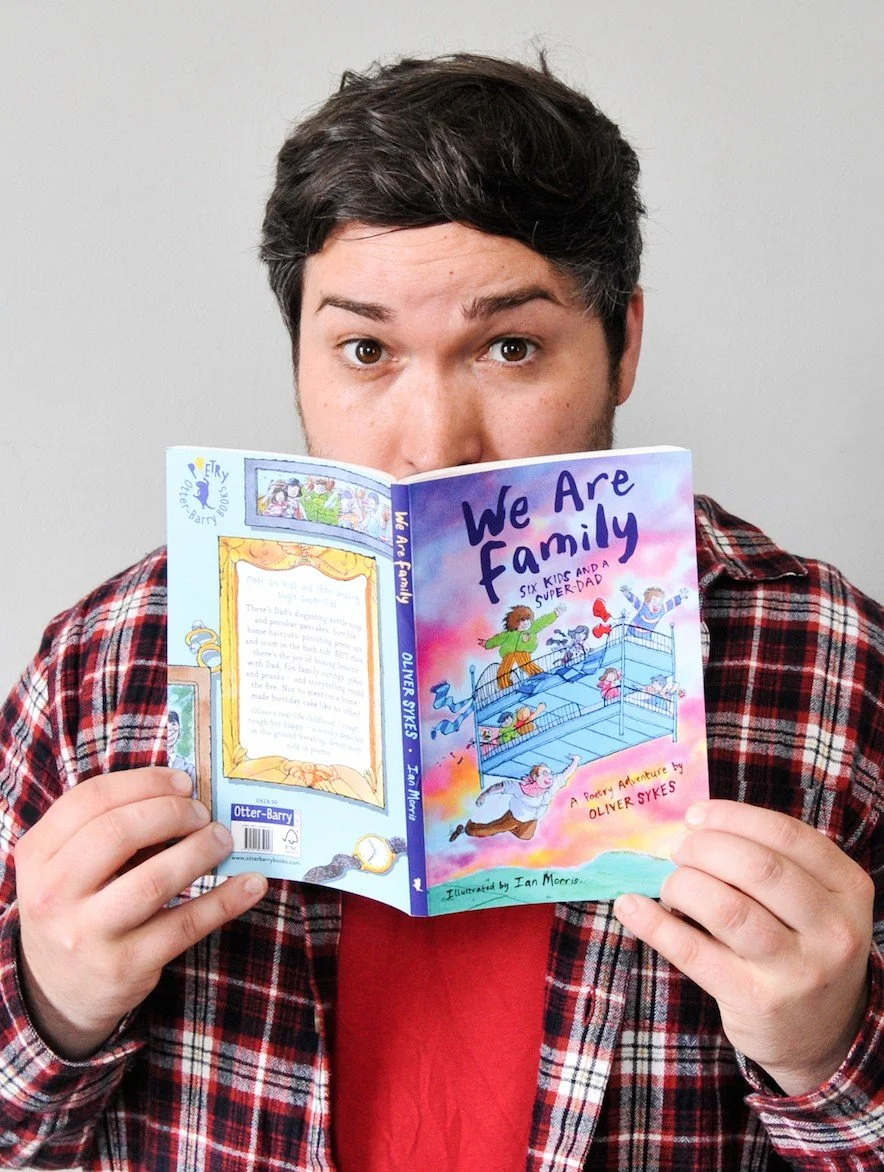
His first verse novel, We Are Family: Six Kids and a Super-Dad (Otter-Barry Books) won the Special Recognition Award at the 2025 Children’s Literature Festivals Book Awards, and was shortlisted for the 2025 CLiPPA Book Award, The Week Junior Book Awards 2025 ‘Children’s Poetry Book of the Year’ and the 2025 Stockport Children’s Book Award. Praised by BookTrust as ‘excellent’ and by Schools Reading List as ‘fantastic,’ it has also been endorsed by top authors and poets including Roger McGough, Phil Earle, Rashmi Sirdeshpande, Ben Davis, and Dom Conlan.
His debut novella, Alfie’s First Fight, won Best Illustrated Young Reader at the 2023 Children’s Literature Festivals’ Book Awards, with the late-great Alex Wheatle MBE describing it as ‘Compelling!’
Beyond writing, Oliver is a passionate workshop leader and performer, regularly bringing his stories and poems to life in schools, theatres and libraries. Together with his partner Gwen, Oliver also co-founded Your Story. Their youth-led story club has opened the doors of reading to children and families who might not otherwise have engaged with their local library – an impact that librarian Meira Jones described as ‘a whole new world of books and stories.’
In November 2024, Oliver became the Patron of Reading at Ysgol y Castell, Rhuddlan.
In March 2025, Oliver was awarded an MBE for Services to Access to the Arts for Underprivileged Young People.
Oliver lives with his partner Gwen, their baby daughter, Ida, and their German Shepherd, Luna.
What a visit from Oliver entails
Oliver’s days in school vary but typically he offers 1x assembly performance and 2-3x workshops (for primaries), and mainly workshop-based visits for secondary’s. He is happy to liaise with schools to tweak these to fit their needs.
Oliver is able to offer either a drama or creative writing workshop to complement the performance. He is an experienced, DBS-checked workshop facilitator and is able to deliver an informal or formal education workshop.
You can see details on his visits here
Testimonials from previous visits.
“Since January 2020, Oliver has been in residence at our school, delivering dedicated workshop sessions to a small group of Year 4 pupils. Each session includes an animated reading of a chapter from his debut novel, ‘Alfie’s First Fight’, followed by themed writing exercises and boxing skills demonstrations. Our pupils are clearly engaged by the story, which is as much about boxing, as it is about courage, loyalty, family and community, and is based on Oliver’s own experience of being brought up by a single father – a rare and valuable narrative in children’s fiction, particularly for our pupils. I have been delighted by our pupils’ response to this project and they always look forward to these fantastic sessions with Oliver.”
Stanley Grove Primary Academy
“Oliver’s workshop was profound. He worked incredibly well with a mixed-ability group, creating a safe space for our pupils who felt comfortable exploring their lives and expressing themselves at what is a crucial point in their lives.”
Cringle Brook Primary School
“Oliver’s educational strand is very strong and I like the fact that it offers a range of ways to support the curriculum, both thematically and in specific drama techniques.”
Manchester Children’s Book Festival
Interview with Oliver Sykes
You are fantastic at ensuring people from all backgrounds and circumstances have a chance to enjoy literature. Why is it so important that books are accessible to all, what impact can it have?
I believe books and stories are for everyone and if society is ever to be truly democratic then all points of view need to be heard. Currently, they’re not. There’s a huge disparity between the reality of life for the majority of people in the UK, and the writers and perspectives that populate mainstream media. By widening and improving opportunities for working class children and their families to engage with literature – to see their voices, people and culture represented – I believe we empower those people, encourage greater empathy and understanding from others and we make society fairer.
You have a long list of award wins and nominations (big congratulations) when you write a story do you keep in mind what judges look for or are you focused on the readers when you sit down to write?
To be honest, the thought of what a judge is looking for in a story has never even occurred to me. I guess I’m far too distracted by my own personal mission, which is to authentically represent the lives of working class children in the stories that I tell.
Don’t get me wrong, its wonderful when my stories appeal to judges – this year’s been a really good one with We Are Family: Six Kids and a Super-Dad being shortlisted for six national awards and being voted for by children to win the special recognition award at the Children’s Literature Festivals’ Book Awards – but (for me) that’s probably only happened because I’ve tried my best to write a story that, as well as having a broad appeal, will chiefly represent, entertain, comfort and inspire working class children.
You won an MBE for your services to access to the arts for underprivileged young people, what actions have you taken/being involved with do you think had the biggest impact?
It’s difficult to choose one thing because my career in the arts spans 14 years and I’ve been the driving force behind so many creative projects - but - one project that stands out is Stories Of Care, a non-profit organisation that I co-founded with Sophie Willan in 2015. Stories Of Care was a dynamic and ambitious writing and outreach organisation based in Manchester, which addressed the underrepresentation of Care Leavers as authors in Children’s Literature.
We helped to build stronger communities by giving marginalised young people, mostly from Care-experienced backgrounds, a safe and supportive setting where they made new friends, shared experiences and supported each other. Participants were empowered over long periods of time to develop their writing craft, work towards having their first published short story for children and become creative leaders in their communities, providing relatable role models for children-in-Care.
Stories Of Care’s Children’s Writing and Professional Development Programme enabled:
• 25 participants to have their work published (96% of its intake)
• 1,400 young people to participate in writing workshops and professional development activities; and
• Over 5,000 children from disadvantaged backgrounds received a free copy of one of Stories Of Care’s critically-acclaimed books, including Tales of the Weird the Wild and the Wonderful (2015), Tales of the Bold the Brave and the Beautiful (2022), Alfie’s First Fight (2022) and Fishing For Rainbows (2023)
Do you think there is a good book match for everyone and that enjoyment is just about finding what suits them?
Yes, I most certainly do.
If a primary school books you for a visit what can the staff and students expect?
My most recent stage adaptation fuses performance poetry and family friendly stand-up comedy. It’s raucous, like a comedy or music gig, with pupils spontaneously clapping along to the rhythm of poems and eagerly awaiting opportunities to join in and shout out, with me playing the role of ring-master, trying my best to contain their excitement. You can expect to see lots of little light-blub moments –pupils having lots of fun and being switched on to the magic of stories.
As for my workshops, I encourage pupils to put their own lives and experiences at the heart of their own storytelling, championing their voice, people and culture. I make my workshops as inclusive and accessible as possible, adapting activities to appeal to the pupils’ strengths in order to build confidence and ensure they have an unforgettable experience.
How are your secondary visits different?
My secondary school visits are much more workshop-led (see above). Small performances of my poems are peppered throughout. But again, it’s about encouraging pupils to put their own lives and experiences at the heart of their own storytelling, championing their voice, people and culture, and assuring them that their lives are important and worthy of being their inspiration for storytelling.
What has been one of your most memorable moments from a school visit?
When I returned to my old primary school, I got to stand in the assembly hall that I sat in hundreds of times as a child. Only this time I wasn’t in the 300-strong audience. I was performing. It was a full-circle moment for me. Lots of different emotions flying around throughout the day, but mostly, joy. Plus, it was billed as a Homecoming visit, so the excitement amongst the pupils was electric. The performance I gave was one of my best, with hilarious adlibs and moments that made the show unique to the audience. It’s a memory I’ll always cherish.
You are heavily involved with the theatre and shows too, how different is script writing from novel writing?
For me, script writing is all about writing how I speak and writing for a live audience, so my sentences are much shorter, they’re often incomplete and grammatically incorrect, which is how I think we all speak. I’m also constantly on the lookout for opportunities to include questions, encourage audience interaction and ask for some Call-and-response.
Once I have a script, I’ll perform about 10 Script-in-hand shows (where I’m holding the script as I’m performing), and I’ll stop briefly to tick bits that go down well with the audience and I’ll make small notes as I go. From here, I’ll graduate to a Work-in-Progress show, where I’ll learn the script and start blocking my movements. Before touring a show professionally, I’m keen to make it the very best it can be, so I’ll perform about 10-20 Work-in-progress shows. At the end of the Work-in-progress shows, I’ll facilitate a quick Q&A session to test the audience’s comprehension and make sure I’m communicating the show’s theme or story arch clearly. Throughout the show-making process, I’m always listening to the audience’s response and I’m using their feedback to make the show stronger.
For me, novel writing is quite different to this. The process is more of a solo venture. It includes a lot of time sitting at a desk – planning, writing, editing, sipping cups of tea, getting it wrong, revising, starting again. It may be take me several months to pull together a finished story (that I’m happy with). Then, and only then, the collaboration begins. Sometimes, the editing of the story will be quick and easy, but other times, it can be lengthy and challenging. But, by working hard and sticking at it, so far, I’ve always managed to create books and stories that I’m very proud of.
How much of your stories do you plan out before you start writing them, and how much is seeing where the characters and your ideas take you?
When I first started writing for children, back in 2015, I was definitely a planner. But these days, I find I’m able to trust my instincts and let the characters take me where they want to go. I still do some planning, but it’s much more character-led. I find character-led planning leads to much better dialogue and action, some of which (even as the writer) surprises me.
What advice would you give to adults trying to ensure young people enjoy books as well as screen time?
If you know a young person who is interested in a television show or a movie or a computer game that has been adapted from a book, then I would highly recommend buying them that book. I think that’s a great way to spark an interest in reading.
But mainly, based on the work my partner Gwen and I have done as Co-Directors of Your Story, I think a youth-and-story-led approach are what work best.
We listen to children and young people, and give them as much agency as possible in how they engage with books and stories. We also make books and stories more accessible by exploring and experiencing them through practical and playful activities, rather than concentrating solely on the act of reading itself.
And finally, we do away with the ‘hierarchy of books’ – the idea that a graphic novel or a comic book is somehow less worthy than a classical text – by embracing all forms of story. This way, children’s and young people’s views are validated and celebrated. They’re not being dictated to, and they’re therefore much more likely to engage with books and stories on their own terms.
Which children’s writers have inspired you?
I could honestly write a list as long as my arm, but I’ve managed to narrow it down to my top five children’s poets and my top five children’s fiction writers.
Children’s poets: Benjamin Zephaniah, Michael Rosen, Kenn Nesbit, Valerie Bloom, Roger McGough.
Children’s fiction writers: Anthony McGowan, Jacqueline Wilson, Phil Earle, Alex Wheatle, Roald Dahl.
What do you tend to read for pleasure?
Currently, I’m quite into Young Adult fiction, particularly Dystopian series that blend elements of coming-of-age, survival and gritty adventure – like Patrick Ness’ Chaos Walking series, Suzanne Collins’ The Hunger Games series and James Dashner’s The Maze Runner series.
Representation matters in books and thankfully there has been an increase in more young people being able to see someone who resonates with them in book options. How important is it that staff make sure pupils have access to a range of books and visitors to increase diversity and representation?
It’s vitality important, because we can’t be what we can’t see. One book in particular was to change the course of my life: Roald Dahl’s Danny Champion of the World.
Following Danny through his day-to-day activities, and then into his big adventure, was the the first time I saw myself represented in a book: a young motherless working-class boy, misunderstood at school and being raised by a single-parent dad.
Meeting Danny – a boy who shared my background, experiences and struggles – reinforced my own sense of identity. His very existence made me feel validated, inspired and proud to be working-class, particularly when faced with institutions, such as school that I felt sought to stamp out all trace of my working-class roots. Not only did this book spark my inner-rebel, it also turned me into an avid reader and made me feel worthy to write and tell my own stories and poems.
How do you encourage shy or reluctant pupils to get involved in a visit?
I’m fortunate to be naturally quite silly and disarming. But I do also use a lot of techniques to encourage shy or reluctant pupils to get involved during my visits, too. For instance, during shows or workshops, I’ll gradually build the audience interactions. First, I might ask everyone to join in with some easy call-and-response. Next, I might ask an easy question and I’ll take answers from willing pupils. I’ll be sure to honour whatever a pupil says in response, showing shy or reluctant pupils that they can trust me. Next, I might ask pupils to close their eyes and watch a poem like a movie in their head while I speak the words aloud. Next, I might ask some more questions. After this, I might ask the whole audience to clap their hands to a beat while I rap over it. All of these techniques usually build towards a big moment where, for instance, I might try to get the entire audience to learn the actions and words to a poem’s chorus, and then ask them to perform the poem with me. By this point, hopefully, all students – reluctant or shy – are getting involved and having fun.
What has been the most surprising idea for a story someone has ever shared with you that made your jaw drop in admiration for their imagination?
When I was Lead Artist for Stories Of Care, I facilitated a 20-week Storytelling programme for young people. I remember being blown away when I chatted to Writer, Emmy Clarke, about her idea for her short children’s story, ‘Vampire Hunter Jess’. In it, her protagonist Jess sends text messages to her late-mum, keeping her updated on how she’s doing, asking for advice in times of trouble, etc. It’s so simple and yet so perfectly executed. The story can be found in ‘Tales of the Bold the Brave and the Beautiful’.
Do you believe that one day with an author or poet can leave a lasting impact on young people?
Yes, I do. Throughout my childhood, I would often escape the loudness and busyness of our home by fleeing to the local public library.
When I was nine years old, I’ll never forget my first-and-only childhood encounter with a professional storyteller. I hadn’t intended to watch or join in, but within minutes, I was completely immersed. I, and about twenty other children, became members of Captain Greenbeard’s pirate crew. We travelled on his ship to an island in search of long-lost gold, battling other pirate crews along the way. It was so much fun!
This one-off encounter was a game changer for me. Even as early as nine years old, I learnt how powerful the imagination is. How, in the hands of the right storyteller, you can be transported to another world. It made me want to tell stories. And I don’t think it’s a coincidence that twenty-five years later, I’m telling stories and transforming spaces in libraries, village halls, theatres and schools across the country.
Budget cuts keep impacting the wonder that is libraries. What difference can a well-funded and staffed public or school library make?
Public libraries are (I think) amongst our most vital institutions. They’re one of the few places you can go to where you’re not a customer; you’re not expected to pay for a service. You can just be. They’re often warm spaces where you can get a free tea or coffee. They’re often One Stop Shops where you can get advice and support. And they’re home to the great brains of the world in the form of books, which you can take out and read for free. I believe libraries – both public and school – are a ticket to a better life.
Many books can contain important life lessons and information even if they are fictional. Since they reflect life some of these obviously contain sad or serious moments. Why is fiction a useful tool for helping develop empathy in young people?
Because young people get to put themselves in another person’s shoes, experience what a character experiences in a story, all the emotions. And it’s all happening in their heads. They have time to reflect and process, before taking what they’ve learnt out into the world with them.
Quick Fire
Starter or dessert?
Definitely, dessert! I’ve always had a sweet tooth!
Would you rather be able to turn invisible or fly?
That’s a hard one. I think the experiencing the sensation of flying wins out for me though. What a thrill that would be!
Would you rather have to fight off a zombie, werewolf or vampire?
Definitely not a werewolf… there’s no way that would end well… it’s a toss-up between zombie or vampire and I’m leaning towards vampire because if I wore a string of garlic around my neck and carried a wooden steak on me at all times, I think I’d be all right. Yeah. Vampire.
What makes you happier to see spring flowers blooming or Christmas lights?
Definitely spring flowers blooming. I love watching the world wake up in spring.
Favourite thing to do to relax?
Read a book in bed until I fall asleep. As a new-Dad, trust me, that opportunity doesn’t come around half as often as I would like anymore!
If you were Prime Minister for the day, what law would you introduce?
I would introduce a radical new housing policy to provide quality housing for the poorest in our society, and ensuring that no one is homeless.
Arrange for Oliver Sykes to visit your school
To make an enquiry about Oliver, please contact us as follows
UK visits
Email:UKbookings@caboodlebooks.co.uk
Or contact Yvonne on - 01535 279851
Overseas Visits
Email:Overseasvisits@caboodlebooks.co.uk
Or contact Overseas Manager, Robin - +44(0) 1535 279853